

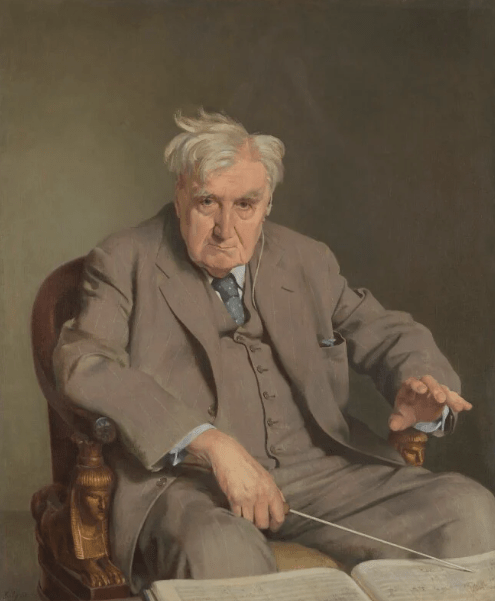
Growing up, there was a lot of classical music in our house. Of the many composers on the turntable, Ralph Vaughan Williams – affectionately known as ‘RVW’ – enjoyed pride of place. It was the soundtrack of my early years.
In more recent times I’ve reacquainted myself ever more with RVW’s output, not least through lesser-known works like the short opera Riders to the Sea, staged brilliantly in 2017 by Midsummer Opera, the company I later came to sing with myself.
A long time ago now, we were fortunate enough to see RVW’s operas Sir John in Love and The Pilgrim’s Progress (RVW called the latter a ‘Morality’, but it’s undeniably an opera) at English National Opera. Both left me floating on a wave of positivity and fellow feeling.
The same thing happened last year with British Youth Opera’s (BYO) production of Sir John in Love at Opera Holland Park. RVW had somehow zeroed in on me as an individual human being and administered some magic formula for making everything feel just that little bit better.
BYO is the opera training company for the UK, and thanks in part to their production of Sir John, we (in a small way) became supporters. I was therefore delighted to learn that BYO were following up Sir John with The Pilgrim’s Progress at this year’s Three Choirs Festival. I was fortunate enough not only to attend the performance in Gloucester Cathedral in July, but also the dress rehearsal. I was inordinately moved by both. Let me explain why.
First, you might find it odd that a humanist like me would appreciate and enjoy a religious allegory. The RVW piece substantially compresses John Bunyan’s proto-novel, but still contains multiple references to God, ‘the Lord’, ‘life everlasting’ and the book (unmistakably the Bible) that the Pilgrim holds in his hand. The Pilgrim’s guide on his journey is ‘the Evangelist’; and Psalm 23 is quoted.
It’s a Christian allegory, and there’s no use denying it. But there is very little Christian doctrine in the text – there’s a kind of assumption that the Christian way is ‘good’, and all others less so, but that the nature of that way has to be surmised through the allegory rather than through any indoctrination. (Worth remembering also that Bunyan was only writing his masterpiece in prison because his version of Christianity differed from that of the established church).
Pilgrim’s Progress is in essence the story of a person’s struggle through life, something it’s perfectly possible to appreciate through a humanist lens. This reflects a general truth: I may not believe in the proclaimed spiritual underpinning of art created in a religious context, but I have my own, different way of appreciating it. Like RVW himself: onetime atheist and later ‘cheerful agnostic’, he changed the principal protagonist’s name from ‘Christian’ to ‘Pilgrim’ to universalise the message. I’m guessing that RVW would probably have felt, as I do, that life is a bit of a messy, complicated business, not amenable to simple or palliative narratives.
The challenges Pilgrim faces, the kinds of people he meets and the resolution (we’d probably call it ‘closure’ these days) he seeks surely resonate with pretty much anyone who qualifies as homo sapiens. Life can be difficult, and it’s very few of us who don’t get to cry ‘what shall I do?’ at some stage in their lives, as Pilgrim does at the outset of both book and opera. The burden he carries – we all feel that at times. The kindness he receives – we all need that at challenging moments in our lives. The armour he is given – we all need a psychological carapace to protect against daily slights and setbacks.
The King’s Highway so central to the piece is the path we all wish to take to a meaningful and fulfilled life. The town of Vanity Fair is the bane of consumerism, the substitution of possession for meaning. The Evangelist is the mentor and the Shepherds the friends we all need to help us on our way. And the River of Death is the final transition from life that we must all navigate at some stage, for many of those we love and for ourselves.
RVW applied a ravishing orchestral and vocal palette to the task of bringing this story to life. I’d argue that the sheer beauty of the writing is one reason RVW’s music isn’t performed more often. It’s tonal, easy on the ear, listenable – just too lush, too uninhibited, too ‘sentimental’ for some listeners. ‘Cow pat’ music, as composer Elisabeth Lutyens opined. Or maybe worse, ‘film music’ (though listen to RVW’s magnificent score for the long-forgotten drama The Loves of Joanna Godden and ask yourself whether that’s really such an insult).
A friend told me they disliked Pilgrim’s Progress because of its religious content and ‘terrible music’. I’m put in mind of when Shostakovich asked Britten what he thought of Puccini. ‘His operas are dreadful,’ responded Britten. ‘No, Ben, you’re wrong,’ said Shostakovich. ‘He wrote marvellous operas but dreadful music.’* Both giants of 20th Century music were wrong: Puccini’s operas are wonderful because of the effect their music and their drama have on the audience.
Same with RVW. I’m not a professional musician – just a keen amateur one – so I reserve the right to judge the music I hear by what it does to and for me, not by how ‘clever’ it is. My benchmark for musical appreciation is the feeling I have in the opera house or the concert hall. That can be partly intellectual – an understanding of context, whether personal (for example, Tippett’s pacifism), political (Verdi and the Risorgimento) or musicological (the Tristan chord) – but in the end it’s the tears, the sense of the sublime and the empathy with other lives that matters. ‘Only connect’, you might say.
For my parents, one reason RVW had such a firm place at the centre of our household’s soundworld was the sense that his music reflected a good version of Britain. It sounded like the music of a country at peace with itself. This wasn’t a conservative outlook: it was hope for change towards a new Britain, a spirit of post-war optimism that maybe, just maybe, defeating fascism wasn’t for nothing and that it was possible to build a society fit for heroes. It was John of Gaunt’s ‘sceptered isle’ speech, minus its ending (which arguably, and tragically, reflects where we are as a nation now).
RVW was capable of angular, angry music too: the 4th Symphony, for example. Even the 3rd, the ‘Pastoral Symphony’ – through the melancholy echoes of a bugler practising in the trenches – has darker undertones. The Dona Nobis Pacem presages the War Requiem’s message of the futility of war. There’s a depth and complexity to his output that the cow pat critics ignore.
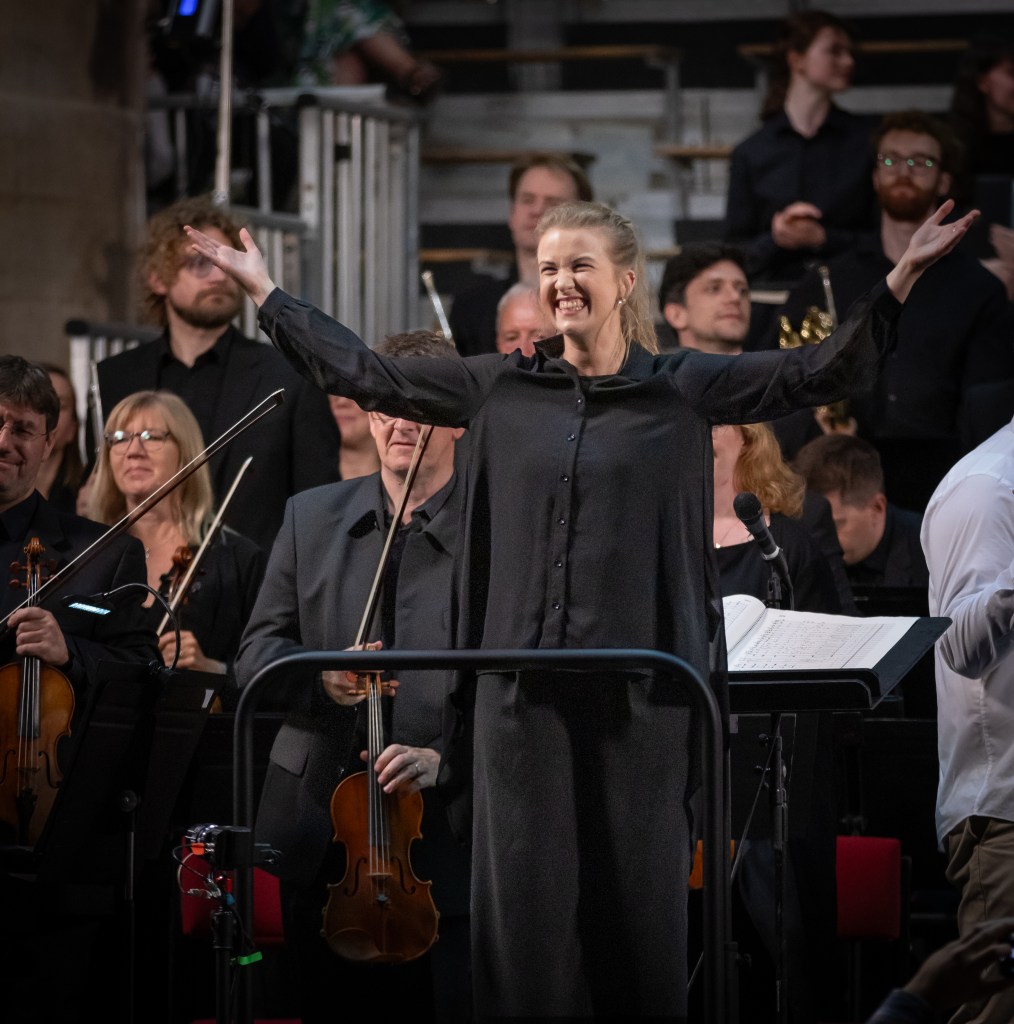

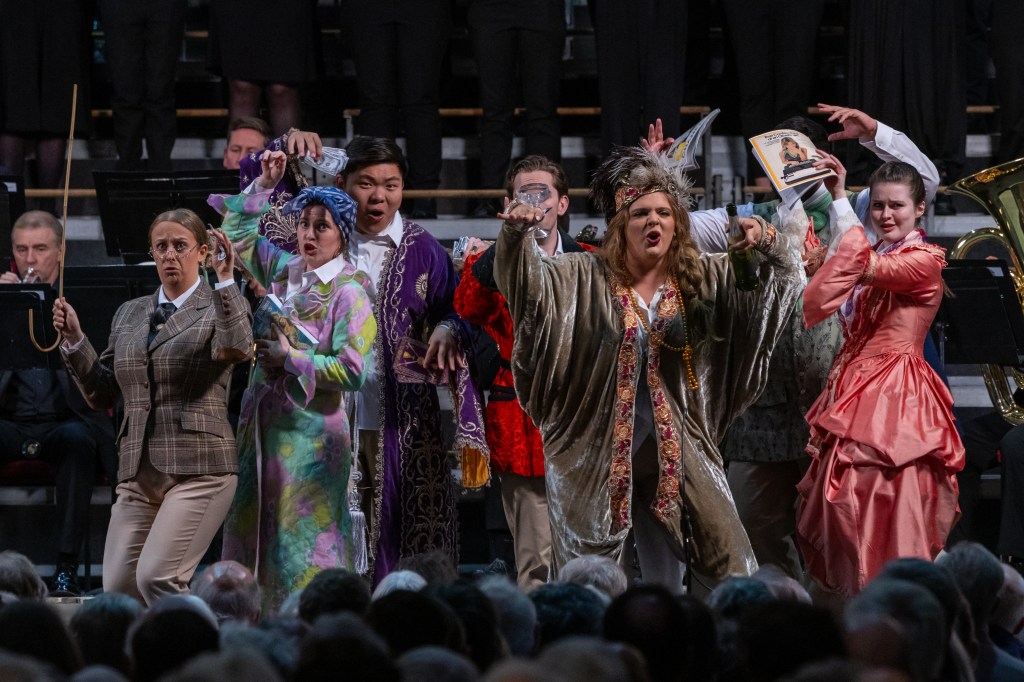
Which brings me back to Gloucester Cathedral, and BYO’s luminescent staging of Pilgrim’s Progress. It’s perhaps pertinent that, though the opera’s premiere at Covent Garden in 1951 fell some way short of success, a 1954 Cambridge production with a young cast elicited from RVW the comment, ‘This is what I meant!’. Perhaps it’s an opera that needs the vitality and energy of youth.
BYO certainly brought that to the performance. Conductor Charlotte Corderoy marshalled the forces of the Royal Philharmonic Orchestra to create a rolling ocean of sound, filling every corpuscle of the cathedral’s full acoustic, sometimes tumultuous, sometimes gently lapping at the shore. (And how wonderful to see so many talented young female conductors like Ms. Corderoy now coming to the fore).
BYO’s remarkable young performers took me on a pilgrimage of my own. I was immersed in every facet of Pilgrim Ross Cumming’s despair and indecision at the outset of his journey, his determination at its crux and his relief at its conclusion (while also marvelling at his stamina at maintaining such a beautiful, powerful timbre through a role which saw him on stage most of the time). I was soothed and inspired by Emyr Lloyd Jones wonderfully sonorous and tender Bunyan, Evangelist and Watchful. I found a place of refuge as ‘Shining Ones’ Issy Bridgeman, Charlotte Jane Kennedy and Angelina Dorlin-Barlow, and Interpreter Matthew Curtis, sang the cathedral’s vaulted ceiling silver.
I could go on, scene-by-scene, singer by singer, but suffice to name all the other principals, not only because they sang and performed to the same exceptional standard, but also because they are the future of British opera and you need to look out for them: Lydia Shariff, Gabriel Seawright, Zihua Zhang, Jia Huang and Armand Rabot. Full credit also to director Will Kerley for creating overwhelming effect with such economy; to the stage crew for their professionalism; and to the Three Choirs Festival Youth Choir for bringing an additional layer of transcendence to the grander scenes.
I don’t know what BYO have planned for next year, but you can bet it’ll be something special and unmissable. They reflect the best of British cultural endeavour, an incubator for our most promising operatic talent (both on- and backstage), and a beacon of hope in a sector facing unprecedented challenges. BYO’s Serena Fenwick programme helps many people into the industry who might otherwise struggle to gain a foothold.
RVW, as one of the bulwarks of Britain’s cultural institutions during his lifetime, would certainly have approved. He would have hoped for government leadership and financial support for an art form which is the best of us: elite, not elitist. And he would have loved to have seen his powerful and beautiful ‘Morality’ reignited for a new generation, by a new generation.
* P. 328, The Book of Musical Anecdotes, Norman Lebrecht. Sphere Books 1987.
 This Page Left Intentionally Blank
Thank you for this wonderful piece: it’s uplifting in its own right. Just recently, I saw the film of Alan Bennett’s Lady in the Van, in which one of Vaughn Williams’ descendants appears. All the best!
LikeLike
Thanks so much for your kind feedback. Will have to seek out Lady in the Van!
LikeLike
Roger – I really enjoyed reading your thoughts on RVW and his Pilgrim’s Progress. Like you it was part of my childhood soundtrack and RVW remained one of my Dad’s favourite composers until his recent death. Dad would certainly have taken issue with any criticism of RVW’s music as film music – as elitist snobbery. Hollywood benefitted from an influx of fine classical composers, like Franz Waxmann, who fled the Nazis to find a new life, as well as the children of other recent immigrants, like Bernard Herrmann. During the same period, the British film industry benefitted from the work of Walton, Bliss and RVW himself. And then there’s Prokofiev’s contribution to Soviet film. Elite but not elitist. As for Pilgrim’s Progress, the whole piece has so much depth and for me is rich with associations. I love the contrast between Pilgrim’s entrance to the Celestial City, with its early rising crescendo and the more modest sound of the epilogue, both based around the psalm tune ‘York’, echoing Bunyan’s time as English Civil War infantry soldier. Fellow Parliamentarian and Commonwealth civil servant, John Milton, wrote a hymn set to York at the height of the Civil War. The words to the second verse (which I think of when I hear the tune) are poignant because of when it was written: “Mercy and truth, that long were missed, Now joyfully are met; Sweet peace and righteousness have kissed, And hand in hand are set.” Music for everyman/woman. Thanks Roger for bringing all this to mind.
LikeLike
Thanks for your lovely comment, Steve – I really appreciate it, and the fact that the blog, so to speak, struck a chord. Great that you mention those composers who fled the Nazis and found themselves working on film. For me, Hermann’s score for Vertigo is one of the great pieces of music, full stop (to say nothing of his remarkable, and very different score for Taxi Driver). I confess I hadn’t made the connection between ‘York’ and Bunyan’s time as a Parliamentary soldier. The Milton hymn you quote is wonderful, and a sentiment as much needed today as in its own time. Perhaps rather belatedly, writing the blog has led to me joining the Vaughan Williams Society, so I look forward to more adventures in the great man’s company. All the very best, Roger.
LikeLike